


Buy the iPhone 12 mini if you want the smallest, cheapest 5G iPhone you can hold in one hand. Buy the iPhone 12 if you want a bigger 6.1-inch screen and roughly two more hours of battery. Everything else, including the A14 Bionic chip, the dual 12 MP cameras, and iOS 26 support, is identical on both phones.
The iPhone 12 mini and iPhone 12 launched together in 2020, and they remain popular picks on the refurbished market in 2026. Because they share the same chip, cameras, and 5G, the choice comes down to size, battery life, and price.
Below is a full side-by-side comparison covering display, design, battery life, software longevity, and refurbished pricing so you can choose with confidence.
Reasons to choose the iPhone 12 mini
- Easier to handle with one hand thanks to its compact 5.4-inch frame
- More affordable, both new and refurbished
- Delivers the same A14 Bionic performance and camera quality as the iPhone 12
- Slightly sharper display with a higher pixel density (476 PPI vs. 460 PPI)
- One of the last truly compact iPhones Apple ever made, a rare form factor in 2026
Reasons to choose the iPhone 12
- 6.1-inch screen for more comfortable video watching, typing, and multitasking
- Longer battery life with up to 17 hours of video playback
- Faster wireless charging speeds (15W MagSafe vs. 12W on the mini)
- The notch feels less intrusive on the larger display
iPhone 12 mini vs. iPhone 12: Differences
| Features | iPhone 12 mini | iPhone 12 |
|---|---|---|
| Dimensions | 5.18 x 2.53 x 0.29 in 131.5 x 64.2 x 7.4 mm | 5.78 x 2.81 x 0.29 in 146.7 x 71.5 x 7.4 mm |
| Weight | 4.76 oz / 135 g | 5.78 oz / 164 g |
| Display size | 5.4-inch Super Retina XDR OLED | 6.1-inch Super Retina XDR OLED |
| Resolution | 2340 x 1080 at 476 PPI | 2532 x 1170 at 460 PPI |
| Battery capacity | 2,227 mAh | 2,815 mAh |
| Battery life | Up to 15 hours of video playback | Up to 17 hours of video playback |
| MagSafe charging | Up to 12W | Up to 15W |
| Price (new) | Starting at | Starting at |
| Price (refurbished) | Starting at | Starting at |
iPhone 12 mini vs. iPhone 12: Similarities
- Apple A14 Bionic chip with 4 GB RAM
- Dual 12 MP camera system (wide + ultra-wide) with Night Mode and Deep Fusion
- 4K video recording at up to 60 fps
- Super Retina XDR OLED displays with Ceramic Shield front glass
- Corning-made glass back with aluminum frames
- 5G connectivity (sub-6 GHz and mmWave)
- Face ID biometric authentication
- MagSafe and Qi wireless charging
- IP68 water resistance (up to 6 meters for 30 minutes)
- iOS 26 compatibility with continued security updates
- Same storage options: 64 GB, 128 GB, and 256 GB
iPhone 12 mini vs. iPhone 12: How do they compare?
Both phones are built on the same foundation, so the real differences come down to three areas: display size, physical dimensions, and battery life. Here is a closer look at each.
Display
The display is the most obvious point of divergence. The iPhone 12 mini has a 5.4-inch screen, while the iPhone 12 offers a 6.1-inch panel, and those extra seven-tenths of an inch make a noticeable difference in daily use.
On the larger iPhone 12, UI elements sit further apart, the keyboard keys are bigger, and content like web pages and social feeds simply shows more at a glance. On the mini, the notch occupies a larger share of the screen and can feel more intrusive, particularly in apps that use the status bar area.
There is no difference in screen quality. Both use Apple's Super Retina XDR OLED technology with the same brightness (625 nits typical, 1,200 nits HDR peak) and True Tone support. In fact, the iPhone 12 mini is technically sharper at 476 PPI compared to the iPhone 12's 460 PPI, though the difference is invisible to the naked eye.
Both models share one shortcoming: a 60 Hz refresh rate. By 2026, high refresh rates have become standard across almost every price tier, so scrolling feels less fluid here than on newer phones. If smooth scrolling matters to you, consider stepping up to an iPhone 13 or newer.
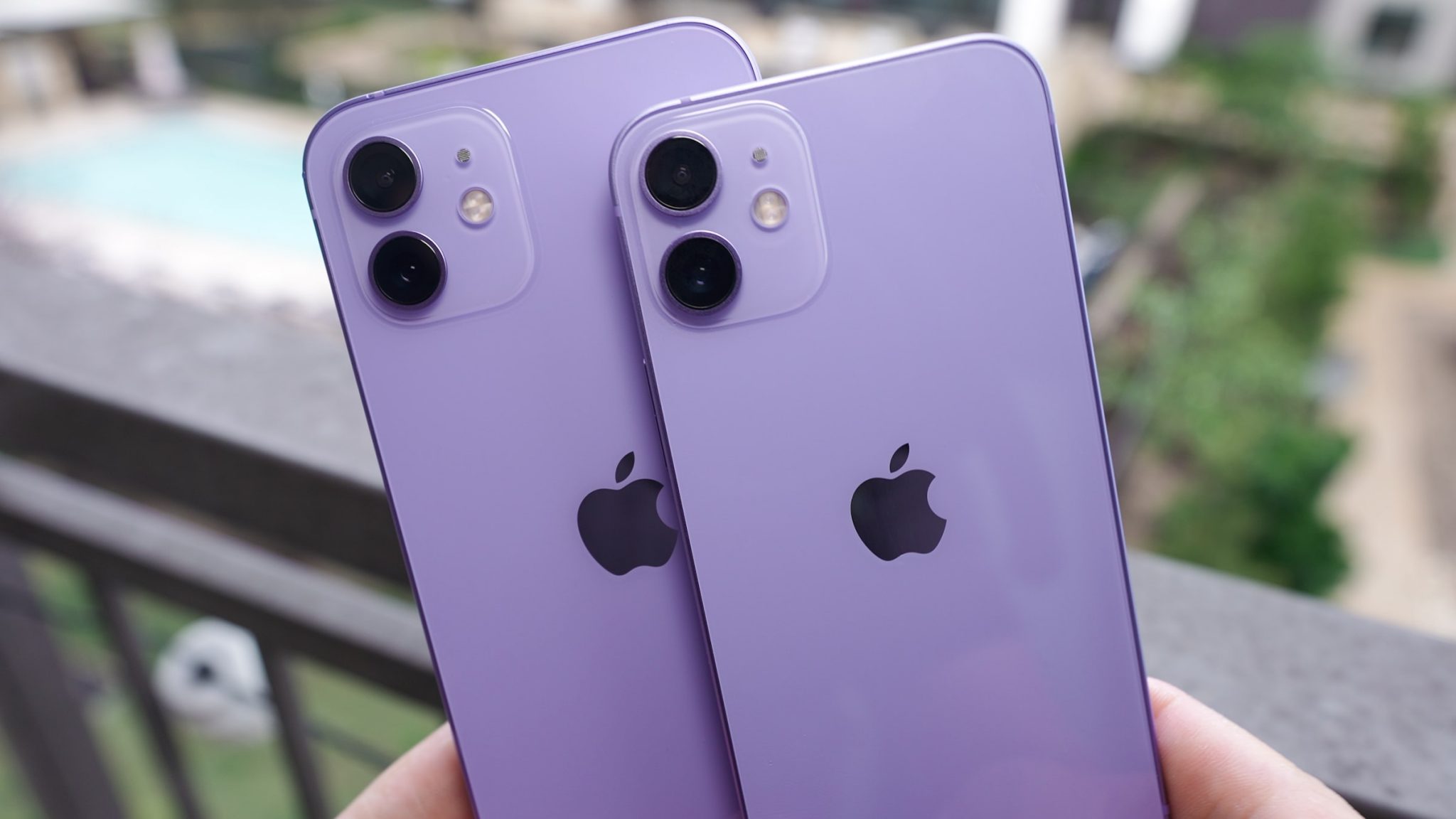
iPhone 12 mini (left) and iPhone 12 (right)
Design and dimensions
Unlike some budget iPhone models, such as the iPhone SE 3 which still uses an older body style, the iPhone 12 mini is a scaled-down replica of the iPhone 12. Both feature the same flat-edge industrial design inspired by the iPhone 5, the same matte aluminum frame, and the same five color options.
The key difference is handling. At 131.5 x 64.2 mm and just 135 grams, the mini is one of the most pocketable smartphones ever made and easy to operate with one hand. The standard iPhone 12, at 146.7 x 71.5 mm and 164 grams, is still compact by modern standards but requires two hands for some tasks.
That compact form factor is part of what makes the iPhone 12 mini an excellent first phone for kids and teenagers. It is also one of the last truly small iPhones Apple produced, since the mini line was discontinued after the iPhone 13 mini.
Battery life
Battery capacity is the most practical trade-off in this comparison. The iPhone 12 carries a 2,815 mAh cell, while the mini makes do with 2,227 mAh, a roughly 21 percent smaller battery.
In Apple's own estimates, the iPhone 12 delivers up to 17 hours of video playback, while the mini tops out at 15 hours. Real-world results vary, but the consensus from years of user feedback is clear: the iPhone 12 offers noticeably longer screen-on time, especially during power-hungry activities like 5G browsing, GPS navigation, or gaming.
If you are a light user who mostly texts, scrolls social media, and streams some music, the mini's battery will get you through a day. Heavier users should either choose the iPhone 12 or keep a charger handy.
One additional note: the iPhone 12 supports 15W MagSafe wireless charging, while the mini caps out at 12W. Both support 20W wired fast charging with a compatible adapter sold separately.
Software longevity
Both the iPhone 12 mini and iPhone 12 run iOS 26, the latest major release, and continue to receive security updates from Apple. Apple confirmed that iOS 26 supports iPhone 11 and later, so the entire iPhone 12 line moved onto the current software cycle rather than being left behind.
Based on Apple's historical pattern of roughly six to seven years of support per device, both models are expected to keep receiving updates through at least 2027. That gives either phone real software life ahead, though buyers should expect that major feature updates will eventually taper off before security patches do. For a longer runway, an iPhone 12 vs. iPhone 13 comparison or a look at the iPhone 12 mini vs. iPhone 13 mini might be worth your time.
Conclusion
The iPhone 12 mini and iPhone 12 are remarkably similar phones separated by one core question: do you want the smallest possible package, or do you want more screen and more battery?
Choose the iPhone 12 mini if you value one-handed use, pocket-friendly dimensions, and the lowest possible price for a capable 5G iPhone. It is the better pick for light users, students, and anyone who prefers compact devices.
Choose the iPhone 12 if you prioritize a larger display for media and productivity, longer battery life, and faster wireless charging. It suits heavier users and anyone who spends extended time on their phone each day.
Either way, both phones deliver strong performance for everyday tasks in 2026, and their OLED screens remain excellent by any standard. Buying refurbished is a smart way to get either model at a fraction of the original cost. On RefurbMe, you can compare live prices from multiple trusted refurbishers that include a warranty and a professional inspection process.
Browse refurbished iPhone deals below.
You can also explore the best places to buy refurbished iPhones to make sure you are getting the best deal.
Frequently asked questions
For a deeper look at update timelines, see our guide on how long Apple supports iPhones.
Explore more iPhone comparisons:
Last updated: Jun 22, 2026 · First published: Sep 17, 2024